If you’ve invested in an air purifier, you’re already thinking about the air quality in your home, that’s the first step. But here’s the catch: the filter is where the real work happens, and if you’re not replacing it on schedule or choosing the right type, your purifier might as well be decorative. Whether you’re dealing with pet dander, dust, cooking odors, or volatile organic compounds (VOCs) from paint or flooring, the right air purifier filter makes the difference between clean air and expensive stagnant air. This guide walks you through the main filter types, when to swap them out, and how to get the most performance from your system.
Table of Contents
ToggleKey Takeaways
- True HEPA air purifier filters capture 99.97% of particles 0.3 microns or larger, making them the standard for effective home air filtration.
- Activated carbon filters are essential for removing odors and volatile organic compounds (VOCs) that HEPA filters cannot address.
- Replace pre-filters every 4–8 weeks, HEPA filters every 6–12 months, and activated carbon filters every 3–6 months to maintain optimal performance and prevent motor strain.
- Proper placement and sizing matter: position your air purifier with 12 inches of clear space on all sides and match the CADR rating to your room size.
- Run your air purifier continuously or at least 12–16 hours daily, keeping doors closed to prevent cleaned air from diffusing into other areas.
Understanding Different Types of Air Purifier Filters
Not all air purifier filters are created equal, and most modern units use a multi-stage approach. Understanding what each stage does helps you pick the right purifier for your space and know what you’re actually paying for when you buy replacement filters.
HEPA Filters and How They Work
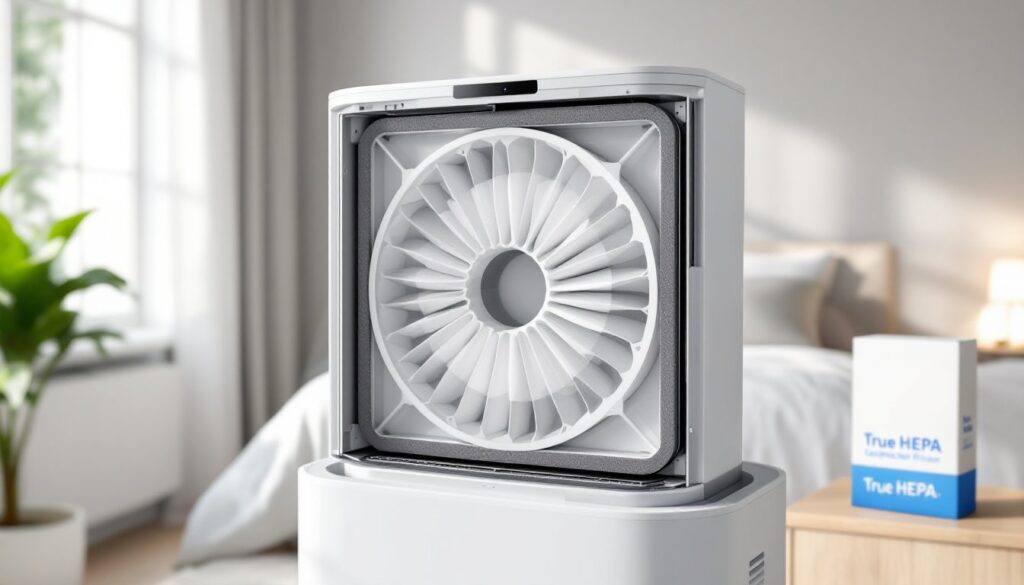
HEPA stands for High-Efficiency Particulate Air, and it’s become the standard for serious air filtration. A true HEPA filter captures at least 99.97% of particles 0.3 microns or larger, that includes dust mites, pollen, mold spores, pet dander, and most allergens. The filter itself is a dense mesh of fiberglass fibers arranged in a pleated pattern to maximize surface area.
Here’s how it works: air flows through the filter, and particles get trapped by three mechanisms, interception (particles follow the airstream but touch the fiber), impaction (larger particles can’t navigate tight curves and slam into fibers), and diffusion (the tiniest particles bounce around randomly and eventually hit a fiber). Unlike a basic screen filter, HEPA doesn’t just block larger stuff and let the fine particles pass through.
When shopping, watch for marketing speak. “HEPA-type” or “HEPA-like” filters don’t meet true HEPA standards and may only capture 85–90% of particles. A true HEPA filter will be labeled as such, and most decent air purifiers made for residential use carry it. These filters typically need replacing every 6–12 months depending on air quality and usage.
Activated Carbon Filters for Odor and VOC Removal
HEPA excels at particles, but it does nothing for gases and odors. That’s where activated carbon filters come in. Carbon is treated with oxygen to create a porous structure with millions of tiny holes, imagine a microscopic sponge. When air passes through, molecules of odor, smoke, and VOCs adsorb (chemically bond) to the carbon surface.
Activated carbon is especially useful if you’re dealing with cooking smells, pet odors, smoke, or chemical off-gassing from new furniture or flooring. It’s also the reason some purifiers are quieter near the source of the smell, the carbon is working before those molecules spread through the room. But, carbon filters saturate over time: once the pores are full, they stop working. They typically last 3–6 months, depending on the pollutant load.
Many air purifiers stack these two stages: a pre-filter (captures large debris), HEPA layer (handles particles), and activated carbon (tackles gases and odors). Some also add a UV-C light stage or ionizer, though the effectiveness of those extras varies and isn’t regulated the same way HEPA is. Stick with HEPA and carbon as your baseline, that combination handles the majority of household air quality issues.
When and How Often to Replace Your Air Purifier Filters
The most common mistake homeowners make is ignoring the replacement schedule. A clogged filter doesn’t just reduce efficiency, it can actually trap contaminants and reduce airflow, forcing the motor to work harder and shortening the unit’s lifespan.
Check your purifier’s manual first: manufacturers give specific timelines based on the filter’s design and the unit’s intended use. As a general rule: pre-filters last 4–8 weeks, HEPA filters last 6–12 months, and activated carbon filters last 3–6 months. These estimates assume typical household use (8–12 hours daily). If you have pets, live in a dusty area, or run the unit 24/7, filters will clog faster. Air quality monitors or filter-status lights on newer models take the guesswork out, when the light changes color or the app notifies you, it’s time to order.
Don’t wait for obvious signs like reduced airflow or bad smells. By then, the filter is already saturated and your air purifier isn’t pulling its weight. Some models allow you to wash pre-filters (rinse gently, air-dry completely before reinstalling), but never wash HEPA or activated carbon, both are damaged by water and lose effectiveness.
Replacement costs vary. A quality HEPA filter runs $40–$80, carbon filters $15–$40, and full multi-stage replacement kits $60–$150, depending on brand and purifier size. Buy filters from the manufacturer or certified retailers to avoid counterfeits, which are common online and don’t perform to spec. Top-rated models like those tested by lab-certified air purifier reviewers help you understand what filter performance actually looks like in real homes.
Maximizing Filter Performance in Your Home
Installing the right filter is only half the battle. How you set up and maintain your purifier determines whether you’re getting genuine air quality improvements or just running an expensive fan.
Placement matters. Put your purifier in the room where you spend the most time, typically the bedroom or main living area, rather than in a closet or corner. Air needs to flow freely around the intake, so keep at least 12 inches of clear space on all sides. If you have an open-concept home and multiple zones, consider a purifier per room or a whole-home system integrated with your HVAC, though that requires professional installation.
Sizing is critical. Air purifiers are rated by Clean Air Delivery Rate (CADR), which measures how many cubic feet of clean air the unit produces per minute. Match the CADR to your room size: a small bedroom needs a lower CADR than a large open living space. Undersized units will run constantly without keeping up: oversized units are overkill and waste energy. According to independent testing of 2026 air purifier models, CADR ratings are key to understanding whether a unit will handle your space.
Run it consistently. Air purifiers work best when running continuously or at least 12–16 hours daily. Intermittent use doesn’t give the system time to recycle the air enough times to capture accumulating particles. A timer or smart plug lets you automate this, run it while you’re home, scale back when you’re away.
Close doors and seal leaks. Your purifier can only clean the air it can reach. If you’re running it in one room with the door open to hallways and other rooms, you’re diffusing the cleaned air. Close the door, or run multiple units. Seal large gaps under doors or around windows with weather stripping, cleaner air stays in.
Change the pre-filter on schedule. Many homeowners ignore the pre-filter, thinking only the HEPA matters. The pre-filter catches large dust and hair, protecting the HEPA layer underneath. Neglect the pre-filter, and your HEPA clogs twice as fast. Some 2026 air purifier comparisons highlight units with easy-access pre-filters because that’s one of the biggest pain points for owners.
Conclusion
Air purifier filters do the heavy lifting in keeping your home’s air clean. Understand the difference between HEPA and activated carbon, stick to a regular replacement schedule, and position your unit for maximum airflow. Do that, and you’ll actually feel the difference in air quality, fewer dust bunnies, less odor, easier breathing. Skip it, and you’ve got an expensive paperweight collecting dust.